
Blizzard in Northeast USA: Let's talk baseball
The art of pitching

Engineered Deception: The Physics, Sticky Stuff, and Exploding Arms of Modern Pitching
It has been a remarkably cold and snowy winter across much of the Northeast. While the freezing temperatures and snowdrifts persist outside, looking forward to the arrival of spring provides a much-needed mental shift. The 2026 World Baseball Classic is right around the corner, running from March 5 through March 17, 2026.
To prepare for the upcoming international tournament, let’s conduct a comprehensive, methodical breakdown of the physics, mechanics, and strategy shaping the modern game of pitching, and look ahead at where the engineering of the game is taking us.
The History and Evolution of the Pitch
The evolution of pitching is a timeline of mechanical workarounds designed to combat changing rules and hitter adaptations.
In the 1850s, pitchers were essentially allies to the batter, required to pitch for the bat until players like Jim Creighton introduced a wrist snap in 1858 to create unprecedented speed and movement.
Candy Cummings is widely credited with inventing the curveball in the mid-19th century, proving that pitchers could rely on spin and deception rather than raw physical power to neutralize hitters.
During the Dead-Ball Era (1900-1919), pitchers dominated by manipulating the baseball with foreign substances, mastering the spitball and the knuckleball.
The transition into the Live-Ball Era in the 1920s brought a livelier baseball and the banning of the spitball, forcing pitchers to innovate to survive.
This constraint led to the popularization of the slider in the 1920s by George Blaeholder, which bridged the gap between the velocity of a fastball and the movement of a curveball.
Following the 1968 season, where Bob Gibson posted a 1.12 ERA, Major League Baseball lowered the mound from 15 inches to 10 inches to reduce the gravitational and mechanical advantage pitchers had achieved.
The Current State: Pitch Design and Seam-Shifted Wake
Pitching has moved out of the bullpen and into the biomechanics lab. We are no longer guessing how a ball moves; we are reverse-engineering the exact kinetic release required to build custom arsenals.
Data-Driven Pitch Design: Facilities like Driveline Baseball utilize 3D Doppler radar and high-speed cameras to map exact pitch shapes and spin axes.
Biomechanical Optimization: Modern labs track a pitcher’s center of gravity, posture, and rotational energy transfer to maximize output while monitoring workload to prevent catastrophic arm failure.
Seam-Shifted Wake (SSW): Pitchers are now engineering movement that operates independently of the Magnus effect. By gripping the ball so that a smooth patch of leather faces the batter during flight, the airflow separates asymmetrically across the seams. This aerodynamic shift creates a pressure differential that forces the ball to move unpredictably, causing pitches like sinkers and changeups to deviate drastically from their expected spin-based trajectories.
Pitching Strategy & Philosophy
The ultimate objective on the mound is system efficiency—maximizing outs while managing pitch count and arm fatigue.
The primary goal when throwing any pitch is to start the hitter’s bat.
A lot of pitchers are scared of making contact with the bat, when in reality, 63% of fairly batted balls result in an out in the majors.
If a pitcher gets the batter to start the bat, they eliminate the chance of a ball, and have the opportunity to get a strike from a missed swing or a foul ball.
For repertoire development, it is a good idea for every pitcher to start off trying to develop the classic sequence: a fastball, a changeup, and a breaking ball.
Fastballs: Grips and Trajectories
The foundation of any pitcher’s repertoire relies on the fastball, establishing the baseline velocity and arm action that all other pitches will play off of.
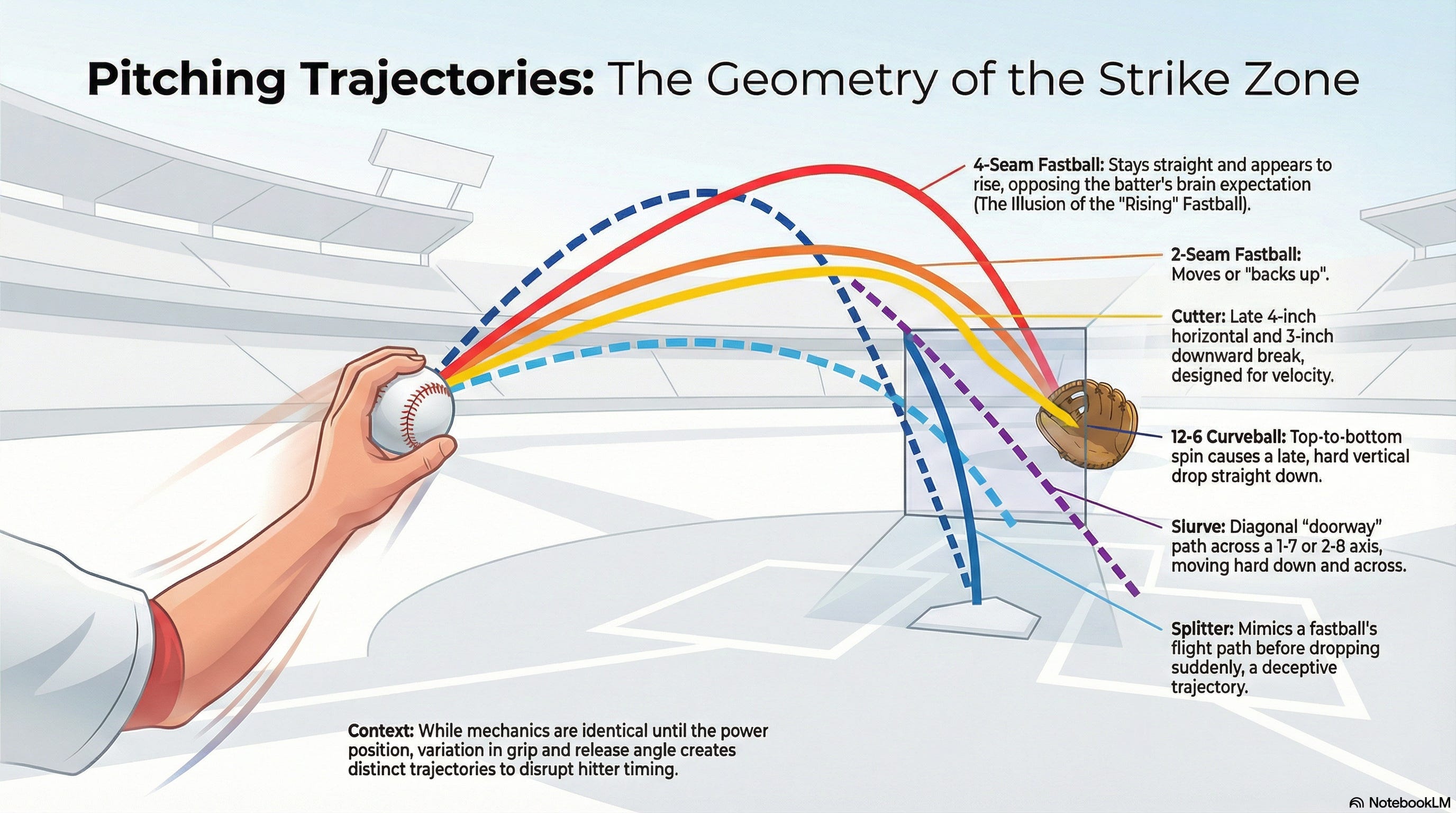
4 Seam Fastball: This is your basic fastball, and the first pitch taught to a young pitcher. It is held across the wide seams, meaning all four seams will be rotating towards the plate. The fingers should be fairly close together to avoid unnecessary forearm tension, which slows arm speed. The pitch must be thrown out in the hand. The lack of movement can make it easier for the hitter to locate, but its greatest value is maximum velocity.
2 Seam Fastball (With the Seam): The pitcher will place their index and middle fingers along the narrow seams, at the top of the horseshoe. This adjustment in grip will create a tailing away action. This pitch is more likely to create groundballs than the four seam fastball.
Cutter (Cut Fastball): When thrown correctly, the pitch should give short, quick, late movement, roughly 4 inches across and 3-4 inches down. The pitcher will continue over the ball, throwing the top of the ball and almost hooking the pitch.
Off-Speed Pitches: Disrupting Timing
Off-speed pitches are the mechanical counterweight to the fastball, engineered to look identical out of the hand but arrive at the plate with drastically different timing and depth.
Changeup: This is a contrast pitch, meaning it is used to disrupt a hitter’s timing once they’ve grown accustomed to seeing power pitches. It should have the same release point, arm speed, and extension as the fastball, but the pitcher finishes with the palm out, facing the arm side. A good rule of thumb is that it should be about a foot slower than their fastball. The three-finger changeup centers the ring, middle, and index fingers on top of the ball. The circle change forms a circle with the thumb and index finger on the inside of the ball.
Splitter (Split Finger Fastball): The splitter is effective for many of the same reasons as the changeup. We take a two seam fastball and just keep splitting the fingers. It comes up to the plate looking like a fastball, loses velocity, and drops.
Breaking Balls: Manipulating Spin and Angle
Breaking balls rely heavily on the pitcher applying specific rotational axes to the ball to maximize the Magnus effect, causing dramatic shifts in trajectory.
12-6 Curveball: Named for its break’s motion as plotted against the face of a clock (straight down). With the breaking ball, we want to throw the front of the ball, creating top spin. The throwing motion is something akin to a karate chop, going straight up and down from the power position.
Slurve: A pitch that’s very similar to the 12-6 curve, with an adjustment in angle that changes the axis of rotation closer to 1-7 or 2-8, breaking hard down and across instead of just down. Instead of coming straight up and down, the pitcher needs to adjust to a three-quarter angle so that they can throw the front and outside of the ball.
Spin Rates and Kinetic Data
You hear the term “spin rate” constantly in modern broadcasts. It is the most critical metric for understanding a pitcher’s effectiveness. Spin rate is the measurement of how many revolutions per minute (RPM) the baseball makes as it travels to the plate.
Historically, we only measured velocity. With the advent of high-speed cameras and Doppler radar systems, we capture the exact kinetic profile of a pitch. Spin rate matters because of fluid dynamics—specifically, the Magnus effect.
A four-seam fastball is thrown with intense backspin, which pushes downward on the air, causing the air to push upward on the ball. This aerodynamic lift creates the optical illusion of a “rising” fastball. It resists gravity and stays higher in the strike zone longer than a hitter’s brain calculates.
Conversely, with a breaking ball, the pitcher throws the front of the ball to create topspin. High topspin forces the ball to dive sharply in the direction of gravity.
The higher the spin rate, the more extreme this applied Magnus force becomes, leading directly to unhittable movement.
The Pitch Clock: Mechanical Impact
There is a widespread narrative that the MLB pitch clock is destroying arms and causing a massive spike in injuries. Pitching is an unnatural, violent mechanical motion, and forcing pitchers to work faster feels inherently riskier.
However, recent biomechanical data indicates the issue is workload density. Pitchers are facing more batters per game because the pace of play has increased, forcing them to be more mechanically efficient with less recovery time between pitches. The timer eliminates the ability to stall and reset physically. When cardiovascular fatigue sets in under a strict timer, mechanical breakdown occurs, leading to increased stress on the ulnar collateral ligament (UCL) and shoulder.
The “Sticky Stuff” Arms Race
Despite MLB’s highly publicized crackdowns, pitchers are still engineering ways to cheat using tacky foreign substances. The physics here are straightforward: more friction between the fingers and the leather equals a higher spin rate upon release. This creates unhittable movement without requiring the pitcher to throw any harder.
What they use: Pitchers historically used pine tar, but the modern arms race introduced “Spider Tack,” an industrial-grade, resin-based paste originally designed to help strongmen grip massive Atlas stones.
How it helps: A dab of Spider Tack can instantly add 300 to 400 RPM to a fastball, turning an average major league pitch into an elite, bat-missing weapon.
How they evade the umpires: Umpires perform routine checks of the hands, belts, and hats between innings. To circumvent this, pitchers blend illegal tack with legal rosin and sweat so it feels natural to the umpire’s touch. They also hide tiny amounts of the substance inside their gloves, deep in their belt loops, or even behind their ears, applying it mid-inning when the umpires aren’t actively searching them.
The Next 20 to 25 Years: Hitting the Limits of Human Kinematics
Looking ahead over the next two decades, the engineering of pitching is going to shift out of necessity. We are rapidly approaching the absolute tensile limits of the human ulnar collateral ligament. The future of pitching will not be defined by who can throw 110 mph, but by how technology dictates pitch execution and biological preservation.
Real-Time Algorithmic Load Management: In-game, markerless optical tracking systems (evolving from current tech like KinaTrax and Hawk-Eye) will instantly read a pitcher’s kinetic chain during a game. Algorithms will alert the dugout the exact moment a pitcher’s rotational energy transfer degrades by a fraction of a percent, triggering a pitching change before the ligament fails, effectively ending the traditional “pitch count.”
AI-Optimized Pitch Sequencing: Catchers will likely receive pitch calls directly from an AI model in the dugout. These systems will analyze the hitter’s real-time bat path data against the pitcher’s specific spin metrics for that exact day, outputting the mathematically optimal sequence to generate a swing-and-miss.
Designing for the Automated Strike Zone: As Automated Ball-Strike (ABS) systems (”robo-umps”) become the standard, the human element of pitch framing will drop to a zero-value skill. Pitchers will engineer “shape-shifting” pitches designed purely to clip the absolute mathematical boundaries of the 3D strike zone, regardless of where the catcher sets their glove.